
A while ago I ran a productivity workshop at work, and one topic kept coming back in almost every discussion: people are tired – not because they are lazy, but because their attention gets pulled in a hundred directions all day.
In my last two posts, I wrote about the “inbox problem” and why habits matter more than tools. This post is the next building block, because it explains why modern work feels so draining even on days where you “didn’t really do anything.” The culprit is context switching.
What context switching really costs you
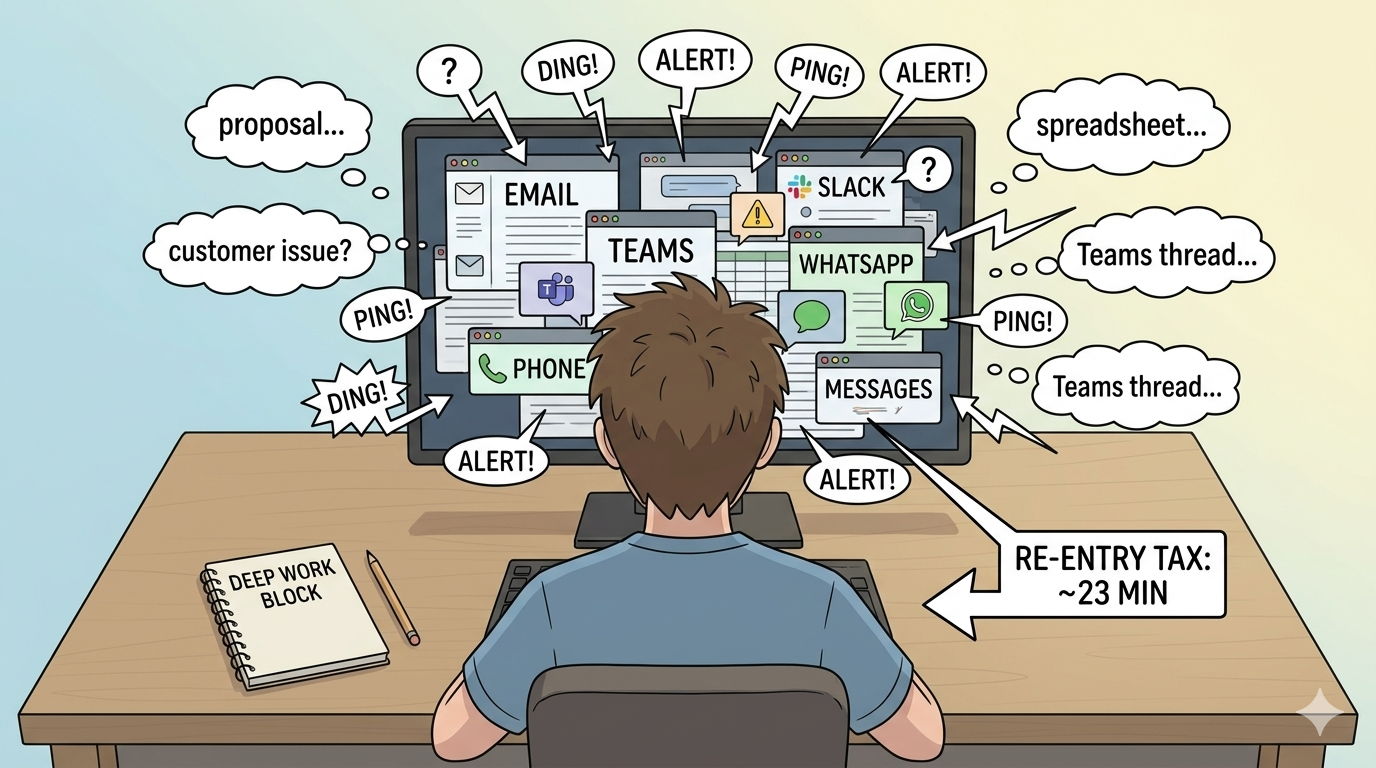
Context switching is what happens when you jump from one mental “world” to another: from writing a proposal to answering a Teams message, from a customer issue to a budget discussion, from a spreadsheet to an email, back to the spreadsheet, then to WhatsApp.
The switch itself looks small. Sometimes it is only 10 seconds. But your brain does not instantly snap back into deep focus when you return.
Researchers like Gloria Mark (UC Irvine) found that after an interruption it can take up to around 23 minutes to fully regain focus (see: The Cost of Interrupted Work: More Speed and Stress (Mark, Gudith, Klocke, 2008)). That number is not a magic constant – sometimes it is faster, sometimes it is slower – but it captures the brutal reality: the real cost of an interruption is not the time you spent on it. The real cost is what happens after.
So if you get interrupted frequently, you are paying this “re-entry tax” all day.
The modern interruption machine: email + chat + everything else
For a long time, many people only had one main inbox: email. It was already imperfect, but it was at least one place.
Today, most of us have multiple inboxes:
- Microsoft Teams or Slack
- WhatsApp or personal messaging
- Phone calls
- Meetings that “just need 15 minutes”
Microsoft’s Work Trend Index reported averages like 117 emails and 153 Teams messages per day for knowledge workers. Even if your numbers are lower than that, you probably recognize the feeling: you can’t go long without something popping up.
And the pattern is predictable:
- You start the day with a plan.
- The messages begin.
- You respond quickly because it feels responsible.
- By lunch, the real work has barely moved.
- At the end of the day, you feel exhausted.
This is why the “infinite workday” feels infinite. The volume is high, but the bigger issue is fragmentation.
Attention residue: why you feel mentally stuck
There is another concept that explains the fatigue even better: attention residue.
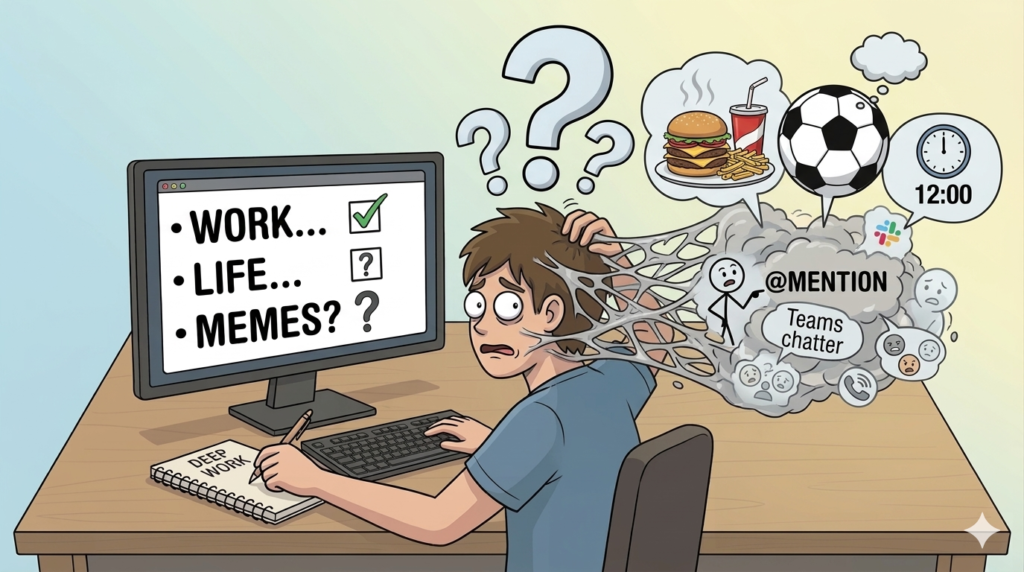
Sophie Leroy introduced the term to describe what happens when you move on from Task A to Task B while part of your mind is still stuck on Task A (Source). Even when you think you switched, you did not fully switch.
That residue hurts you in a few ways:
- You make more mistakes.
- You work slower.
- You reread the same sentence three times.
- You keep thinking about the last conversation while trying to do the next thing.
This is the hidden reason why shallow work feels heavy. Your brain is doing constant background processing to “clean up” the last context.
Why you end the day exhausted (even if you were not productive)
Many people blame themselves for days that feel chaotic. They think they lack discipline or they need a better app. But in most cases, the system is the problem. If your day is built around constant interruption, you are spending your best energy on switching, not on creating. You are burning cognitive fuel on restarts.
The day feels busy because you were busy. You just were not progressing. And this connects directly to the previous post about habits over tools: switching tools will not fix this problem. A new app cannot protect your attention. Only boundaries and habits can do that.
How to reduce context switching (without becoming unreachable)
You do not need to disappear for eight hours. But you do need to create structure. Here are a few practical moves that work in real life.
1) Create message windows
Instead of reacting all day, define a few times when you process communication. For example:
- Mid-morning
- After lunch
- Late afternoon, or before you end your day
When a message arrives, the best default is to ignore it. Turn notifications off, keep working on what you already decided to do, and only check messages during your next message window.
If you are worried you might forget something important, capture it quickly into your task manager and then go straight back to the work you actually want to get done. Most messages are not urgent – they just feel urgent because they arrived.
2) Protect at least one deep work block
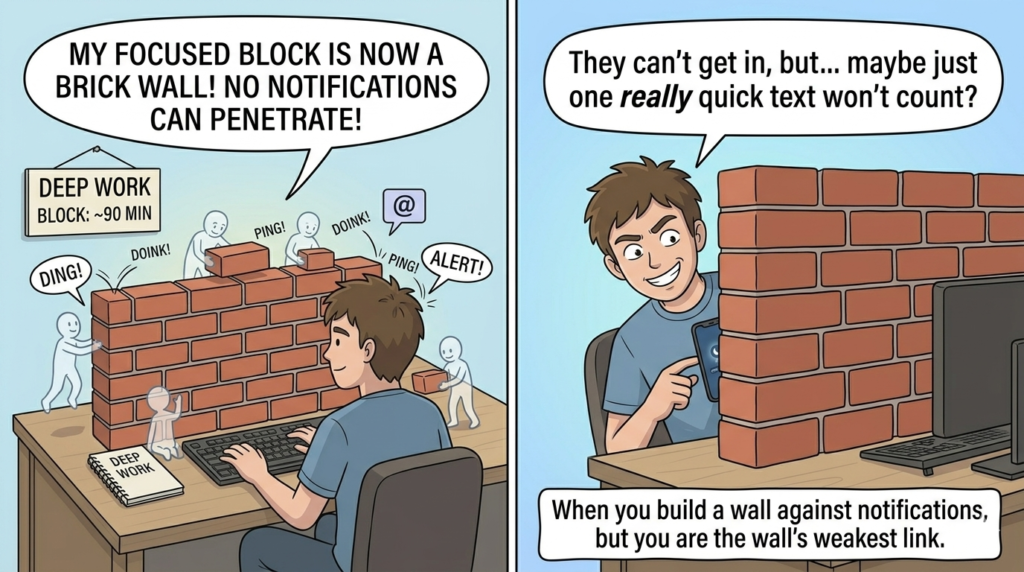
A simple target is one 60-90 minute block most days. Put it on your calendar. Treat it like a meeting with yourself.
If you are a manager, you may not be able to do two long blocks every day. That is fine. One consistent block changes the game.
3) Turn off most notifications
Notifications are tiny interruptions with outsized impact. And when you are dealing with volume (think: 117 emails and 153 Teams messages per day, on average), the only realistic strategy is not “respond faster” – it is “get interrupted less.”
This is where the refocus penalty matters. If an interruption can cost you up to ~23 minutes to fully get back on track, then “just quickly checking” notifications is not a harmless habit – it is a daily productivity leak.
So the best default is: turn them off!
If you want to test this, do it for one morning:
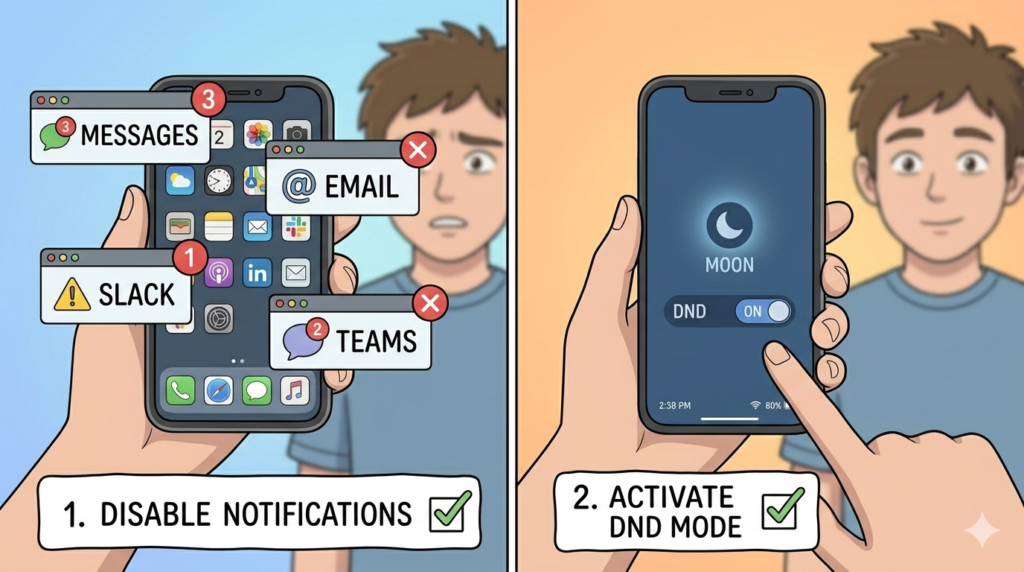
- Turn off desktop popups
- Mute chat notifications
- Keep only truly critical alerts
- Turn on “Do not disturb” mode on your phone and your computer
You will likely notice your brain relax after 20-30 minutes, and you will get more done because you are not paying the 23-minute restart cost over and over again.
4) Use a “capture habit” so you can ignore messages safely
One reason people keep checking messages is fear: “What if I forget?” The fix is not more checking. The fix is capture.
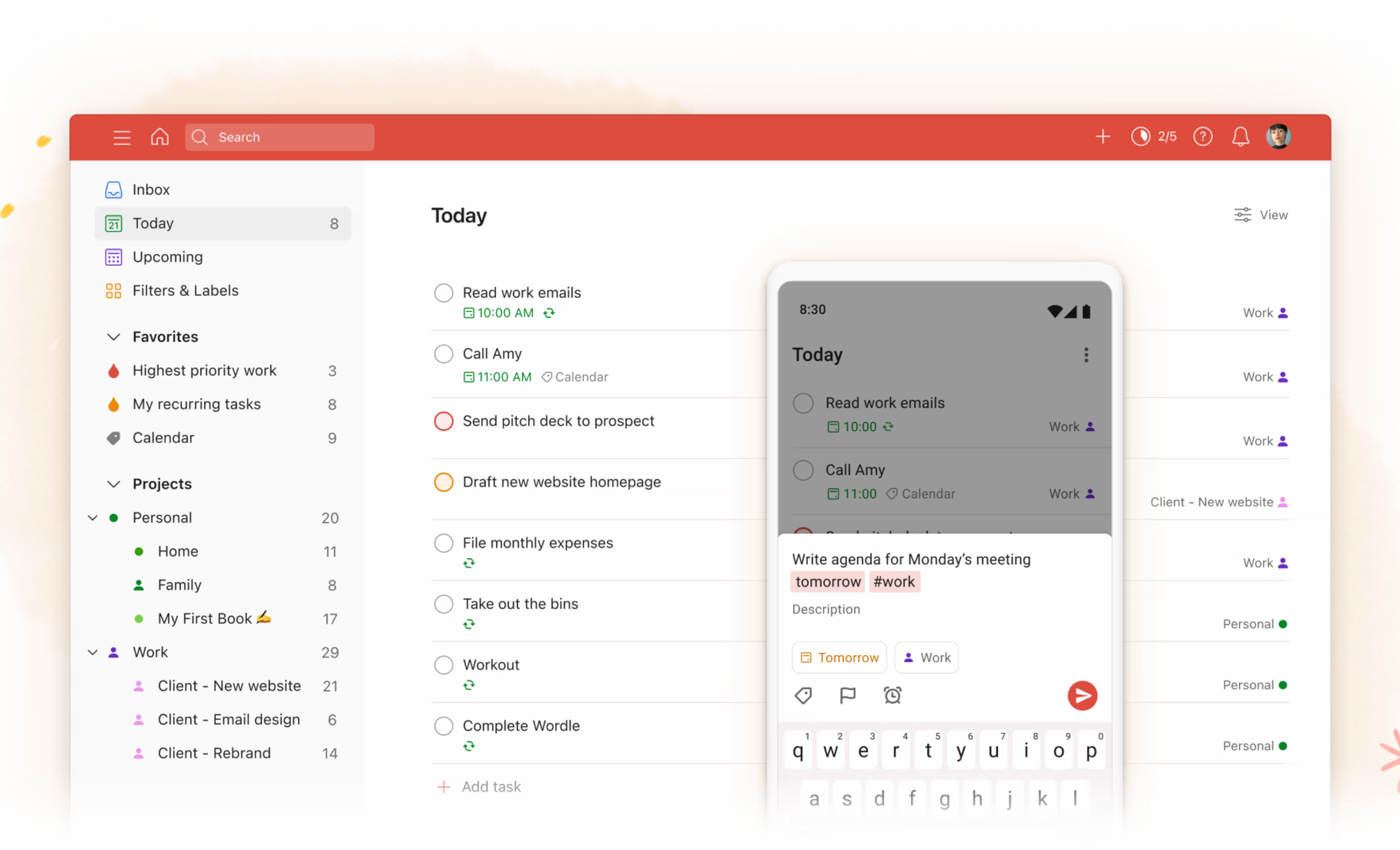
When something comes in that requires action, capture it into one trusted system (your task manager). Then you can ignore the inbox without anxiety, because you know the work will come back at the right time.
This is exactly why I stick with one tool I know well. The tool itself is not magic – but speed matters. When you can capture a task in a few seconds (without fiddling with fields, tags, or perfect wording), you stop living in the inbox. You get the thought out of your head, into a trusted system, and you can immediately go back to focused work.
5) Set expectations with people
This is the part many people avoid, but it is often the most effective.
Tell your team something like:
- “If it’s urgent, call me.”
- “I check messages at 10:30, 14:00, and 17:00.”
- “If you need input today, please add a clear question.”
Most people will adapt quickly, and you will reduce a lot of noise.
The takeaway
Context switching is not a minor annoyance. It is a major productivity killer and a major energy drain. When you understand the 23-minute refocus penalty and attention residue, the solution becomes clearer: you need fewer switches, more structure, and habits that protect your attention.
If you want to start small, do just one thing tomorrow: block 60-90 minutes for deep work and turn off notifications during that time. You do not need a new tool. You need a protected space to do real work.
Sources, mentioned in the post
- Gloria Mark, Daniela Gudith, Ulrich Klocke (2008): The Cost of Interrupted Work: More Speed and Stress
- Sophie Leroy (2009): Why is it so hard to do my work? The challenge of attention residue when switching between work tasks
- Microsoft WorkLab (2025): Breaking down the infinite workday – Work Trend Index Special Report
- Microsoft (2025): 2025 Work Trend Index Annual Report (PDF)